
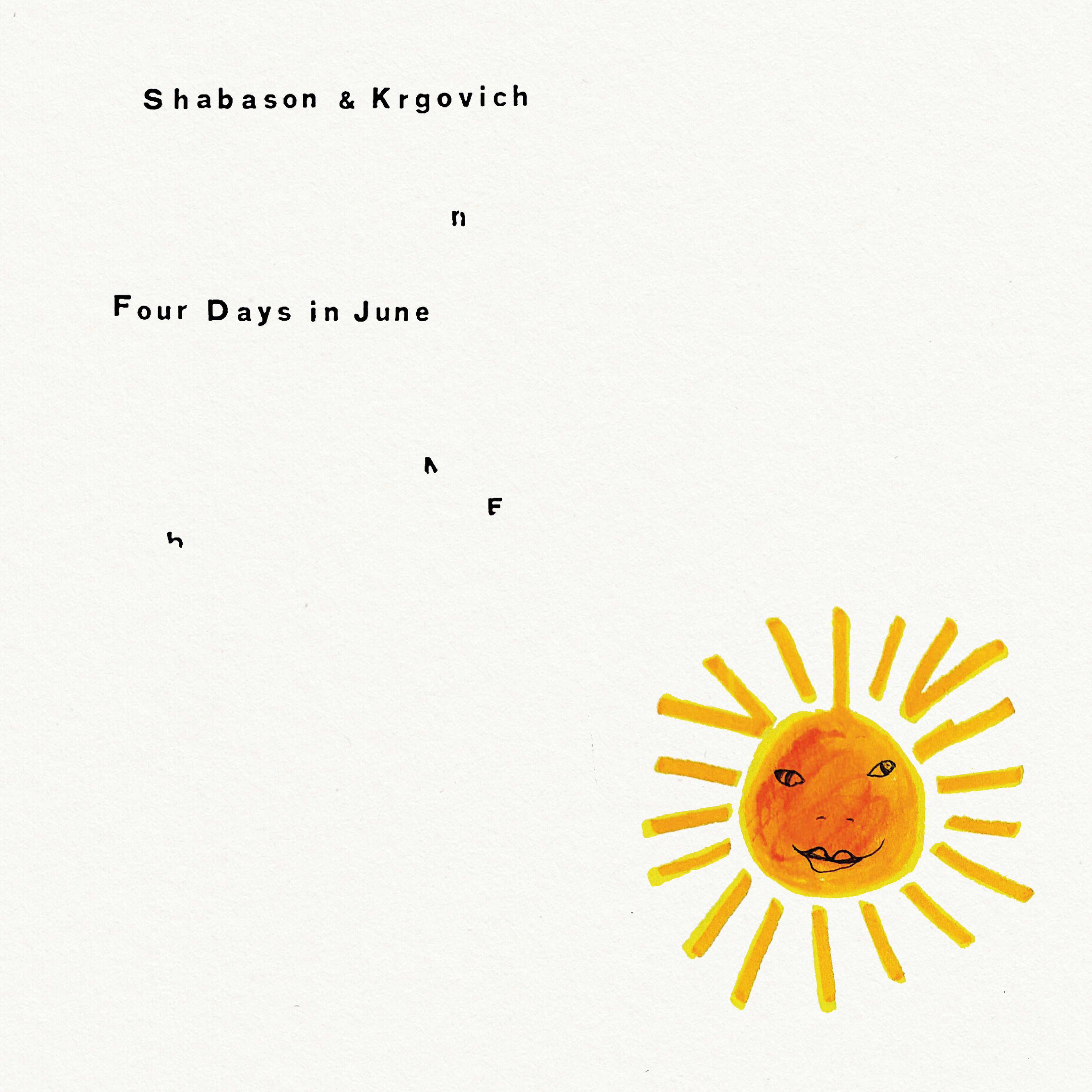
Since their 2020 collaborative album, Philadelphia, Joseph Shabason and Nicholas Krgovich have been locked in a musical orbit that centrifugally extracts beauty and grandeur from the lesser details of their daily lives. Across their joint discography, they’ve created a small universe where wry and melancholy micro-moments quietly bloom into full-scale wonders of the heart. But where the pair’s previous mutual efforts showed them peering at pop songs from tidepools of mutated adult contemporary and first-thought-best-thought poetics, Four Days in June snapshots an unself-conscious reach toward the kind of CD era songcraft that lives in your car’s center console, always ready to be thrown on while life happens. It spiritually grafts its scope from heyday all-timers like “Harvest Moon”, R.E.M., or K.D. Lang’s “Ingenue”, while winking at 90s pop country via flutters of pedal steel, banjo, and fiddle. Yet all of these inspirations remain self-honest and unborrowed, modifying and underlining the crystal-clear sincerity that has come to define Shabason and Krgovich’s co-output. Four Days in June is a document of its authors looking back on their lives half-passed, finding contentment with how things have unfolded. By that very same process, Shabason and Krgovich manage to find quiet confidence in the most naturalistic version of their own creativity.
Four Days in June was indeed born in the summertime, as its title suggests. Spurred by the recruitment of pedal-steel player Ian McGimpsey, Joseph began summoning his tried-and-true core lineup (bassist and keyboardist Bram Gielen, guitarist Thom Gill, and drummer Phil Melanson) to his Toronto studio before he was certain that Krgovich would be able to trek from Vancouver. Nick was fresh off of producing a new album for Tsunami’s Jenny Toomey, and seemingly enjoying the mental space he found when not preoccupied with music. Meanwhile, amid the stress and joy of parenting young kids, and the worsening Parkinson’s complications of his mother (for whom his 2019 solo album Anne is named), Joseph was finding a buoy for day-to-day gravity by diving headlong into music-making.
Shabason and Krgovich found themselves standing on opposite sides of the muse, in alternate dimensions of early middle age, unconvinced that Four Days would bear both of their names. However, Krgovich was tipped into formation upon hearing that his old friend Phil Elverum, and the folk musician Sam Amidon of whom he was a new fan, would be converging in Toronto for respective tour stops at the time Four Days in June was scheduled to be tracked-- In fact, the Four Days lineup would go on to be Elverum’s backing band for that date, and Amidon himself would stop by the studio to contribute banjo and fiddle. The planets had finally aligned, and Four Days in June was born amid an historic Toronto heatwave.
The elation and catharsis of this lead-up are tangible from the album’s very first glistening notes of pedal steel. A slow and steady joy creeps across album opener “Begin Again”, painting a picture of old friends rediscovering each other’s company after some time apart, the smiles breaking slowly across everyone’s faces as they relax into familiarity. The track sets a briskly gentle tone for the rest of Four Days in June’s nodes of post-Adult Contemporary pop, like the driven clap-along “Midday Sun”, the samba-anchored getaway “Road”, and the subtly IDM-inflected “43”. While these crystallizations are meaningful enough on their own, they’re made all the more poignant by the relative dissolution of structure on songs like “Field Mouse” and “No. 2” wherein the sonic sediments never quite settle before Krgovich’s airy vocals wash them lovingly back to sea. This is a glinting hallmark of Shabason’s production; adding humanity to an already human aesthetic, and letting the listener feel as though they’re in the room instead of squinting at a buttoned-up ensemble from the back row. It’s clear that everyone here is an elite performer, but carving any kind of moat around themselves would undermine the coziness that makes Four Days so endearing and affecting.
On the finale “Time of Your Life”, Krgovich’s poetic talents arise to the foreground over a shifting gradient of organ, fiddle, and pedal steel. “Funny how / what having the time of your life / looks like to you now,” he calmly incants about midlife scenes of friends’ weddings, young nieces and nephews, and quiet solitary evenings, before concluding, “if that was the plan, I forgot.” It’s an anthem, of sorts, about what life looks like when it drifts slightly off the societally prescribed path. As he demonstrates here, Nick has a way of bringing the listener into his world by simply noticing the tender corners of daily life, instilling a sense of “Krgovision” that lingers long past a song’s final notes.Having borrowed its title-- half-candidly, half-lovingly-- from the 1993 album Five Days in July by Canadian alt-country icons Blue Rodeo, Four Days in June aims its fond and hazy memories of yesterday’s pop-country toward a distinctive and truthful outcome free of smirk and subversion. Its out-of-character influences give new dimension to the intimacy, snapshot poetry, emotional veracity, and spot-on musicianship that Shabason and Krgovich have sculpted across their collaborative discography.


